
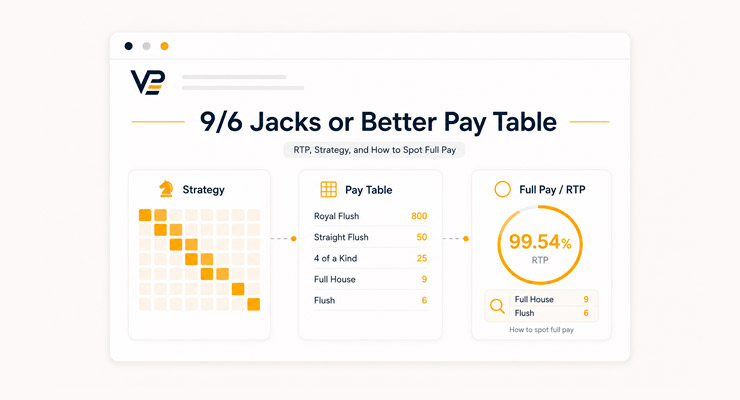
The 9/6 paytable is the full-pay reference for Jacks or Better video poker — the standard version where optimal strategy reaches a 99.54% theoretical return under max-coin bet. The shorthand “9/6” comes from a single line in the paytable: a full house pays 9 credits per credit bet, and a flush pays 6.
This guide walks through the complete paytable, explains why those two numbers determine almost everything else about the game’s math, and shows how to identify a true 9/6 paytable in any venue or online game lobby.
A static comparison table further down shows how 9/6 stacks against the common short-pay variants — 8/6, 8/5, 7/5, and 6/5 — and exactly how much RTP each variant costs. To test the same benchmark values interactively, use the video poker paytable calculator.
Educational content only. Gambling rules, availability, and legal age vary by jurisdiction.
What “9/6” actually means
The “9/6” shorthand encodes two specific paytable payouts. The “9” is the per-coin payout for a full house — bet one credit, hit a full house, the game pays 9 credits. The “6” is the per-coin payout for a flush.
Together, those two numbers identify a specific paytable configuration — the highest-paying standard schedule for this variant, both historically common in physical venues and (less commonly now) on modern game floors.
This naming convention dates to early video poker analysis. Lenny Frome, a gambling mathematician who published several foundational works on video poker math in the 1980s and 1990s, used full house and flush payouts as the natural identifiers because only those two cells reliably differ across common variants of the game.
Royal flush, straight flush, four of a kind, three of a kind, two pair, and Jacks-or-better pairs remain consistent across the standard paytable family — meaning the full house and flush rows alone tell you which variant you are looking at.
“Full pay” in this context means the highest standard payout structure widely available for a given variant. Rare promotional or progressive configurations sometimes exceed 9/6 in theoretical return, but those are exceptions; for everyday play, 9/6 is the reference ceiling.
The 9/6 paytable
| Hand | Per Coin | Max-Coin (5 coins) |
|---|---|---|
| Royal Flush | 250 | 4,000 (800× per coin) |
| Straight Flush | 50 | 250 |
| Four of a Kind | 25 | 125 |
| Full House | 9 | 45 |
| Flush | 6 | 30 |
| Straight | 4 | 20 |
| Three of a Kind | 3 | 15 |
| Two Pair | 2 | 10 |
| Jacks or Better (high pair) | 1 | 5 |
Note on the royal flush row: max-coin bet (5 coins) unlocks the 800× royal multiplier. Playing fewer coins drops the royal payout from 800× per coin back to 250× per coin, which reduces total RTP — see the “Why max-coin matters” section below for the exact figures.
For a focused explanation of the three-of-a-kind row and its draw mathematics, see the trips and three of a kind guide.
9/6 vs 8/6 vs 8/5 vs 7/5 vs 6/5 paytables
The paytable family shares all rows except the full house and flush payouts. Small reductions in those two cells cause large drops in theoretical return:
| Variant | Full House | Flush | Optimal RTP | House Edge |
|---|---|---|---|---|
| 9/6 Jacks or Better | 9 | 6 | 99.54% | 0.46% |
| 8/6 variant | 8 | 6 | 98.39% | 1.61% |
| 8/5 variant | 8 | 5 | 97.30% | 2.70% |
| 7/5 variant | 7 | 5 | 96.15% | 3.85% |
| 6/5 variant | 6 | 5 | 95.00% | 5.00% |
The drop from 9/6 to 8/6 already costs 1.15 percentage points of RTP (reducing the full house payout alone). Dropping further to 8/5 costs an additional 1.09 p.p. — a five-fold increase in house edge from full pay, from 0.46% to 2.70%. Each step further reduces return until 6/5, where the house edge is over ten times the full-pay version.
The strategy chart for 9/6 also applies (with negligible loss) to 8/6, 8/5, and 7/5 — Wizard of Odds documents that using 9/6 strategy on an 8/5 machine costs only about 0.01 percentage points versus the 8/5-specific strategy. For 6/5, strategy differences are larger; if 6/5 is the only option available, learn or look up the 6/5-specific chart.
RTP and house edge under optimal play
The theoretical return-to-player for 9/6 Jacks or Better is 99.54% under optimal strategy and max-coin bet. The corresponding house edge is 0.46%.
These figures are from Wizard of Odds optimal-strategy analysis — the canonical reference for the underlying mathematics, cross-verified across multiple independent sources.
RTP varies measurably with strategy precision. The Wizard of Odds video poker calculator publishes three strategy tiers for 9/6:
- Simple strategy — 99.46% RTP. Approximately 0.08% cost vs optimal, or about 1 wasted bet per 1,178 hands
- Intermediate strategy — 99.52% RTP. Approximately 0.03% cost vs optimal, or about 1 wasted bet per 3,805 hands
- Optimal strategy — 99.54% RTP. The theoretical maximum
The royal flush — the headline outcome — occurs roughly once per 40,000 hands under optimal play. Specifically, the expected frequency is approximately 1 in 40,391 hands. This is a low-probability, high-payoff event that dominates the variance of the game without dominating session-by-session outcomes.
“Theoretical” matters in this context. 99.54% is the statistical mean over very large numbers of hands. Individual sessions deviate widely from this figure due to variance. The number does not mean you will keep 99.54% of any specific bankroll; it means that over millions of hands at optimal play, total returns converge toward 99.54% of total wagered money.
For a broader cross-variant view, see the video poker RTP comparison guide.
How to identify a 9/6 paytable
The key skill is recognising a 9/6 paytable before you play. The title alone is not enough — two machines can carry the same label while using different full house and flush payouts.
Identification is a four-step check:
- Locate the on-screen paytable display. It is always visible (no hidden menus required), typically at the top of the game screen
- Find the Full House row. The per-coin payout must show 9
- Find the Flush row. The per-coin payout must show 6
- Confirm the Royal Flush row: 250 per coin at 1–4 coins, 4,000 at 5 coins (max-coin bonus)
If all four match, it is a 9/6 paytable. If any of them differs, you are looking at a short-pay variant.
Common decoys
Short-pay variants share the game name but ship with reduced Full House and Flush payouts. The RTP impact compounds rapidly over a session — see the comparison table above.
Online lobbies require the same paytable check. The title alone is insufficient — many regulated and unregulated operators ship 8/5 (or worse) under the same label. Open the game info screen, locate the paytable, and confirm Full House 9 / Flush 6 before depositing.
Free-play or demo versions of a game may not match the paytable shipped to real-money play — verify both if you are evaluating an operator.
Why max-coin matters
Max-coin bet — five coins per hand — is structurally non-negotiable for the full-pay version. The reason is the royal flush bonus: at 1, 2, 3, or 4 coins, the royal flush pays 250 per coin. At 5 coins, it pays 4,000 total — equivalent to 800 per coin.
The extra 550 credits per credit of bet (the difference between the 250× and 800× multipliers) is not a minor adjustment; it is a substantial fraction of the game’s theoretical return.
The numerical impact depends on whether the player adjusts strategy to the 1-coin paytable or applies the standard max-coin strategy chart unchanged.
- With strategy optimised for 1-coin play (royal pays 250 per coin), Wizard of Odds calculator returns 99.11%. That is a loss of 0.43 percentage points vs the 99.54% max-coin optimum
- With the standard max-coin strategy chart applied to 1-coin play (no strategy adjustment), the effective return is commonly cited at approximately 98.01% — a loss of about 1.53 percentage points. This is the figure most relevant to typical recreational play, because most players use the standard chart regardless of coin count
Either figure tells the same story: max-coin is the structurally correct choice. The cost of saving the extra credits per hand is a sustained leak in expected return that no strategy adjustment can fully recover.
The practical rule: if 5 credits at your chosen denomination is too expensive, reduce the denomination rather than the number of credits. Full-pay return assumes the 5-credit royal flush schedule; short-coin play removes most of that royal-flush value, whichever strategy is used to compensate.
Strategy requirement for 99.54% RTP
The 99.54% return assumes optimal strategy, not just the right paytable. The math collapses fast under sub-optimal play — a simple strategy applied to a 9/6 machine returns 99.46% rather than 99.54%; an 8/5 strategy applied to a 9/6 machine returns approximately 99.53% (negligible loss); and any unrelated strategy can drag the return well below 99% even on a full-pay paytable.
The high-value priority decisions in the full Wizard of Odds chart include dealt royal flush, dealt straight flush, dealt four of a kind, 4 to a royal flush, dealt full house, dealt flush, three of a kind, dealt straight, 4 to a straight flush, two pair, and high pair — followed by lower-value draws and single-card holds.
This page is about identifying the 9/6 paytable. For exact hold/discard priority, including counterintuitive holds and rare suited-card and penalty-card cases, see the Jacks or Better strategy chart page.
Variance and bankroll note
The game has moderate video-poker variance — approximately 19.51 per hand for single-play, with a standard deviation of 4.42 (Wizard of Odds variance tables). Lower than Full Pay Deuces Wild (~25.83) but higher than non-bonus card games.
Theoretical RTP is a long-run average. Per-session results vary widely around that average due to variance. Extended periods without premium hands are normal: a 1,000-hand session with no royal flush and no straight flush is statistically unremarkable. Convergence toward theoretical RTP requires hundreds of thousands of hands, not hundreds.
The paytable tells you the theoretical return; it does not protect a small bankroll from normal draw variance. Practical bankroll modelling — including Kelly-criterion approaches and risk-of-ruin calculations — belongs on a dedicated bankroll guide that will be published as part of a later content release.
Common questions
Does the venue name matter for finding 9/6?
No. The paytable inspection is the only reliable check. Brand correlates loosely with 9/6 availability — some operators historically carried more full-pay paytables than others — but specific games and machines change over time, and individual games within a venue may differ.
Always verify the Full House (9) and Flush (6) rows on the actual game before sitting down. Crowd-sourced availability resources like vpFREE2 maintain more current information than any single editorial site can.
Is 9/6 available online?
Rarely and selectively. Some regulated online operators offer the 9/6 paytable; many ship 8/5 or worse under the same label. Open the game info screen and confirm Full House 9 / Flush 6 before depositing real money.
Free-play or demo versions of a game may not match the paytable shipped to real-money play — verify both if you are evaluating an operator.
Should I always play max-coin?
Yes for the full-pay version. The royal flush bonus at 5 coins increases the effective royal flush multiplier from 250× to 800× per coin, raising total RTP from approximately 98% to 99.54% (the exact short-coin figure depends on whether strategy is adapted to 1-coin paytable, as discussed in the “Why max-coin matters” section).
If max-coin at your preferred denomination is uncomfortable, drop the denomination instead of the coin count.
How does 9/6 compare to Full Pay Deuces Wild?
Different math, different audiences. 9/6 Jacks or Better returns 99.54% with a 0.46% house edge.
Full Pay Deuces Wild returns 100.76% theoretically — a positive expected value game — but with higher variance and tighter modern availability. Most players who learn both prefer Deuces Wild when available and default to 9/6 when it is not.
Methodology and sources
All RTP, house edge, payout, and strategy figures on this 9/6 Jacks or Better pay table guide are sourced from Wizard of Odds optimal-strategy analysis.
Strategy-tier comparison (99.46% / 99.52% / 99.54%) cross-referenced via Wizard of Odds video poker analyser calculator. Short-coin return (99.11% under 1-coin optimal strategy) verified via direct Wizard of Odds calculator quote; the alternative widely-cited figure of approximately 98.01% reflects max-coin strategy applied to 1-coin play (sub-optimal adaptation).
Short-pay variant returns (8/6 = 98.39%, 8/5 = 97.30%, 7/5 = 96.15%, 6/5 = 95.00%) from Wizard of Odds video poker summary tables and the dedicated 8/6 strategy page. Variance figure (19.51) and standard deviation (4.42) from Wizard of Odds variance reference tables. Royal flush frequency (1 in 40,391) from Wizard of Odds optimal-strategy analysis.
Last verified 12 May 2026. See Editorial Standards for the full verification workflow.
