
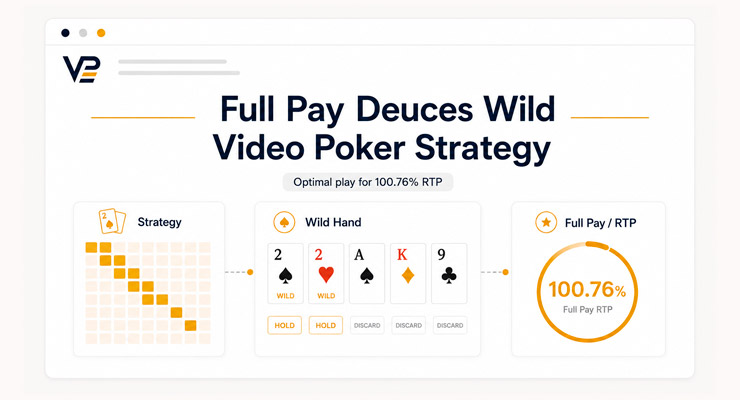
Full Pay Deuces Wild is the positive-EV reference schedule for Deuces Wild video poker. With the 25-15-9-5-3-2 paytable, variant-specific optimal strategy, and 5-credit play, it returns 100.76% theoretical RTP — putting the player on the mathematically favourable side of the game. The “full pay” designation refers to the variable rows: Wild Royal 25, Five of a Kind 15, Straight Flush 9, Four of a Kind 5, Full House 3, and Flush 2 (per credit, at any bet level).
The fastest identification marker is Four of a Kind = 5 credits per credit bet. If that row pays 4, the game is not Full Pay — it is a short-pay variant with substantially lower return. This page covers paytable identification, the optimal strategy framework by deuce count, variance and bankroll considerations for positive-EV play, and where the variant can typically be found.
For the broader game overview, start with the Deuces Wild video poker guide. For paytable identification across variants, see the pay table comparison. For the strategy chart organised purely by deuce count, see the Deuces Wild strategy guide.
Educational content only. Gambling rules, availability, and legal age vary by jurisdiction.
What “Full Pay” means in Deuces Wild
The Full Pay designation specifies the paytable structure that yields the maximum theoretical return — 100.76% under optimal play and 5-credit bet. The complete Full Pay paytable, with per-credit and 5-credit payouts:
| Hand | Per Credit | 5-Credit Play |
|---|---|---|
| Natural Royal Flush | 250 | 4,000 (800× per credit) |
| Four Deuces | 200 | 1,000 |
| Wild Royal Flush | 25 | 125 |
| Five of a Kind | 15 | 75 |
| Straight Flush | 9 | 45 |
| Four of a Kind | 5 | 25 |
| Full House | 3 | 15 |
| Flush | 2 | 10 |
| Straight | 2 | 10 |
| Three of a Kind | 1 | 5 |
Two payouts make this paytable distinctive. The Four Deuces row pays 200 per credit (1,000 at 5-credit play) — a substantial intermediate bonus for the four wild cards landing in a single hand. The Natural Royal Flush row preserves the standard 800× per-credit bonus, paying 4,000 credits at 5-credit play.
The full-pay schedule can be played with fewer than 5 credits, but the 100.76% return applies only to 5-credit play because the natural royal flush pays 4,000 credits at that level. At 1-4 credits, the royal-flush bonus is lower, so the game no longer reaches the headline 100.76% return. Treat the exact short-credit return as a separate calculation unless you have a verified strategy table for that bet level.
100.76% RTP — conditions and meaning
The 100.76% RTP figure carries specific conditions that must all be met:
- Variant-specific optimal strategy — the chart for Full Pay differs from NSUD strategy and from short-pay strategy in marginal plays. Using a non-matching chart costs return; the exact cost depends on the specific schedule and mistake pattern.
- 5-credit play — preserves the 4,000-credit natural royal flush payout. Playing fewer credits lowers the royal-flush value and therefore lowers the total return.
- Sufficient hand volume — variance is high. Theoretical RTP converges only over very large numbers of hands.
- Verified paytable — the game must actually be Full Pay (Four of a Kind = 5, Five of a Kind = 15, Straight Flush = 9, Full House = 3, Flush = 2).
The corresponding house edge is negative 0.76% — a theoretical player edge. In practical terms, that edge expresses itself only over very large hand volumes. The Wizard of Odds estimates that achieving a 90% probability of realising at least 100.66% return (just below the theoretical 100.76%) requires approximately 42,383,720 hands of play. Even tens of thousands of hands routinely produce results well above or below expectation.
For broader context on RTP across video poker variants, see the video poker RTP guide. For comparison with the non-wild-card baseline, the 9/6 Jacks or Better pay table reaches 99.54% RTP under similar optimal-play conditions — a strong game but with theoretical house edge (0.46%) rather than player edge.
Identifying Full Pay versus look-alikes
The fastest Full Pay check is the Four of a Kind row. Full Pay pays 5 credits per credit bet for Four of a Kind. If that row pays 4, the game is not Full Pay.
Common look-alikes:
- Not So Ugly Ducks (NSUD): Four of a Kind drops to 4, while Five of a Kind rises to 16, Straight Flush rises to 10, Full House rises to 4, and Flush rises to 3. RTP under variant-specific optimal strategy: 99.73%. Visually attractive because of the higher Straight Flush and Five of a Kind payouts, but the Four of a Kind reduction is dispositive.
- Illinois Deuces (98.91% schedule): Wild Royal 25, Five of a Kind 15, Straight Flush 9, Four of a Kind 4, Full House 4, Flush 3. Visually close to Full Pay, but the Four of a Kind row drops from 5 to 4.
- Lower short-pay schedules: Any schedule with Four of a Kind = 4 and a reduced Straight Flush row is materially weaker. Use the full paytable comparison before treating the game as playable.
Full Pay verification checklist: Four of a Kind = 5, Five of a Kind = 15, Straight Flush = 9, Full House = 3, Flush = 2, and Natural Royal Flush = 4,000 credits at 5-credit play. All conditions must match. For the full comparison side by side, see the Deuces Wild pay table guide.
Optimal strategy framework
Full Pay Deuces Wild strategy is organised by the number of deuces in the initial hand. The exact optimal chart contains many close expected-value cases and penalty-card refinements; this section presents a compact framework based on the Wizard of Odds optimal strategy ordering, not a full replacement for the complete reference. For edge cases involving suited high cards and rare penalty configurations, consult the Wizard of Odds Full Pay Deuces Wild optimal strategy page.
The base rule across all branches: never discard a deuce.
Four deuces dealt
Hold all four deuces. The Four Deuces payout is 200 credits per credit bet, or 1,000 credits at 5-credit play. Being dealt all four deuces on the initial deal is rare — about 1 in 54,145 hands. The final Four Deuces outcome shown in return tables (about 1 in 4,900) appears more often because four deuces can also be completed on the draw from a three-deuce starting hand.
Three deuces dealt
With three deuces, the hand is already very strong, but it does not automatically guarantee five of a kind. In the Wizard of Odds optimal chart, the priority is: pat wild royal flush first, then “three deuces only” with non-pair discarded, then “three deuces only” with a low pair discarded, then made five of a kind. In most non-royal cases, the correct play is to hold the three deuces and discard the other two cards — even when the other two cards form a pair (which would technically make a pat five of a kind). Breaking pat five of a kind to draw with three deuces preserves the wild royal and four-deuces upside, which has higher expected value than the made five of a kind in most configurations.
Two deuces dealt
Hold both deuces. Priority list (condensed from Wizard of Odds):
- Pat wild royal flush or five of a kind
- Pat straight flush or four of a kind
- 4 to a royal flush
- 2 consecutive suited cards, 6-7 or higher, plus the two deuces
- Two deuces only (discard the other three)
- 2 consecutive suited cards, 5-6 or lower, plus the two deuces
- Full house or less (discard the non-pair structure)
The two-deuces-only hold is common — most two-deuce hands have other cards that do not form a meaningful draw structure above the suited-consecutive threshold.
One deuce dealt
Hold the deuce. Compare the four non-deuce cards. Priority list:
- Pat wild royal flush, five of a kind, straight flush, or four of a kind
- 4 to a royal flush (ranks above pat full house)
- Pat full house
- 3 consecutive suited cards, 5-6-7 or greater
- Pat three of a kind, straight, or flush
- 4 to a straight flush
- 3 to a royal flush, with high card king or less
- 2 consecutive suited cards, 6-7 or higher, plus the deuce
- 3 to a royal flush, ace highest
- Deuce only (discard the other four)
The key counterintuitive ordering: 4 to a royal flush (EV 3.40) ranks above pat full house (EV 3.00). Coming from Jacks or Better, the instinct is to hold the made full house, but the wild royal draw has higher expected value.
Zero deuces dealt
The most common scenario, approximately 65.88% of hands. Strategy resembles Jacks or Better but differs in marginal plays. Priority list (condensed):
- Natural royal flush
- 4 to a royal flush (ranks above made straight flush, four of a kind, and full house)
- Pat straight flush, four of a kind, or full house
- Pat three of a kind
- Pat straight or flush
- 4 to a straight flush, suited 10-J-Q, or 3 to a royal flush
- Pair
- Two pair, 4 to a flush, or 4 to an outside straight
- Lower 3-to-straight-flush and 2-to-royal-flush fragments
- Garbage — discard all
Critical Jacks-or-Better difference: two pair is not held as two pair. Hold only one of the two pairs and discard the other plus the kicker. Which of the two pairs to hold makes no difference in expected value for Full Pay.
For the full chart with penalty-card refinements and rare suited-card exceptions, see the Wizard of Odds optimal strategy reference. The simple strategy (returning 100.71%) is available on the simple strategy page and is sufficient for nearly all play.
Counterintuitive Full Pay plays
Several Full Pay decisions surprise players coming from Jacks or Better.
Hold one pair, not two pair
In Jacks or Better, two pair is a paid hand (1 credit per credit bet) and is always held. In this variant, pairs do not pay — three of a kind is the minimum payout. When dealt two pair, the correct play is to hold one of the two pairs and discard the other along with the kicker. This produces a three-card draw with much higher upgrade potential (to three of a kind, full house, four of a kind) than the held-two-pair draw, which has no payout floor.
Which of the two pairs to hold makes no difference in expected value for Full Pay — both produce identical expected returns. This is unusual; in most video poker variants, pair selection between two equal pairs has some expected-value impact.
4 to a royal beats pat full house with one deuce
When dealt one deuce plus four cards forming a made full house, but also four cards to a wild royal flush draw, the wild-royal draw wins on expected value (EV 3.40 vs 3.00 for the made full house). This is one of the largest counterintuitive transitions from Jacks or Better, where breaking a made full house is virtually always wrong.
Break pat five of a kind with three deuces
When dealt three deuces plus a pair (making a pat five of a kind), the correct play is to discard the pair and hold only the three deuces. The pat five of a kind pays 15, but the three-deuces-only draw has expected return between 15.057 and 15.059 depending on which pair is discarded — slightly higher than the 15.000 pat payout, because of wild royal and four-deuces upside on the draw.
Never discard a deuce
Deuces are always worth more held than discarded. No realistic dealt-hand configuration produces a draw better than the held deuce. The wild card’s contribution to four of a kind, five of a kind, and wild royal completions makes deuces always worth holding.
One Full Pay hand has two equal-EV plays
Wizard of Odds documents one specific hand configuration in Full Pay Deuces Wild — three to a straight flush with two gaps and one straight penalty card — that can be played two ways (four to the straight, or three to the straight flush) with identical expected value of 0.3404 but different standard deviation. The optimal strategy recommends the lower-variance play (four to the straight); choosing either does not affect long-run RTP. This is one of the rare equal-EV exceptions in the Full Pay chart.
Variance and bankroll for positive-EV play
Theoretical edge does not translate to short-term profit. Full Pay Deuces Wild has higher variance than 9/6 Jacks or Better — standard deviation 5.08 per hand for Full Pay Deuces, versus approximately 4.42 for 9/6 Jacks or Better. The corresponding variance is approximately 25.8 (compared to roughly 19.5 for 9/6 J/B). Larger variance means longer convergence requirements and bigger session-to-session swings.
The theoretical player edge at 5-credit play is 0.76% of total wagered. Over 10,000 hands, that equals 50,000 credits wagered and an expected gain of about 380 credits before variance. Realised session results vary widely. The standard deviation of total return over a 1,000-hand session is approximately 161 credits at 5-credit play (5.08 × 5 × √1000) — meaning two-thirds of 1,000-hand sessions fall within roughly ±161 credits of the small theoretical gain of about 38 credits.
Convergence toward the theoretical 100.76% is slow. The Wizard of Odds estimates that achieving a 90% probability of realising at least 100.66% RTP (just 0.10 percentage points below the theoretical figure) requires approximately 42,383,720 hands of play. Coming out merely ahead with 90% probability requires approximately 733,790 hands. The theoretical edge is real but small, and realising it consistently requires sustained volume far beyond casual play.
Positive expected value does not mean short-term profit. Even a mathematically favourable game produces long losing stretches. The 100.76% return is a long-run average, not a session guarantee. Practical bankroll requirements depend on bet size, session length, stop-loss limits, and tolerance for downswings — a dedicated risk-of-ruin analysis is more appropriate than a fixed universal bankroll rule.
Availability
Full Pay Deuces Wild is rare because the base game gives the player a theoretical edge when played optimally. Availability changes by venue, software provider, market, and bet level. This page does not maintain a live availability database.
Before playing, verify the paytable directly in the game interface. The title “Deuces Wild” alone is not enough: many games use the same name with a lower-return paytable. Read the Four of a Kind row first, then the Full House and Flush rows, to confirm the variant.
Online Full Pay Deuces Wild is essentially nonexistent at major regulated operators. The most commonly shipped online structure is the 98.91% RTP variant, sometimes labelled simply “Deuces Wild” without paytable specification. Always check the in-game paytable before depositing.
Common questions
Is Full Pay Deuces Wild really positive-EV in practice?
Theoretically yes (100.76% RTP under variant-specific optimal strategy and 5-credit play). Practically, the theoretical edge is realised only over very large hand volumes with strict optimal play. Variance ensures most individual sessions will still lose money. The theoretical edge is real but small (0.76% per credit wagered), and realising it requires sustained volume far beyond casual play. Players who claim long-term profit on Full Pay Deuces typically combine the theoretical edge with casino comps, promotional cashback, and other player rewards.
Why is Full Pay Deuces Wild rare?
Because the math favours the player. Operators prefer paytables where they retain an edge. Full Pay produces theoretical negative house revenue at optimal player play, so it has been progressively limited over time. The variant survives in pockets where competition forces higher-return offerings, but is uncommon in most modern markets.
How does Full Pay Deuces Wild compare to 9/6 Jacks or Better?
Different math, different audiences. 9/6 Jacks or Better returns 99.54% with a 0.46% house edge; Full Pay Deuces returns 100.76% theoretically — positive expected value — but with higher variance (5.08 vs roughly 4.42 standard deviation per hand) and much tighter availability. Players who learn both typically prefer Deuces Wild when available and default to 9/6 Jacks or Better when it is not. The skill investment is comparable, but the games require separate chart memorisation.
Will using Full Pay strategy on other Deuces Wild variants work?
Approximately. Using Full Pay strategy on NSUD or short-pay machines costs a small additional amount in return beyond the paytable gap itself, but the larger return difference always comes from the paytable, not strategy mismatch. For genuine NSUD or short-pay specialisation, use a variant-specific chart from Wizard of Odds. For occasional play on non-Full-Pay machines, applying Full Pay strategy is acceptable as a practical baseline.
Methodology and sources
RTP figures (Full Pay 100.76%, Simple Strategy 100.71%, NSUD 99.73%, Illinois Deuces 98.91%) sourced from Wizard of Odds Deuces Wild analyses, accessed May 2026. All figures assume variant-specific optimal strategy and 5-credit play unless noted.
Standard deviation 5.08 sourced from Wizard of Odds Risk of Ruin calculator and Ask the Wizard #99. The Wizard of Odds optimal strategy page shows a slightly different figure (5.18) for the entire game including specific borderline-hand choices; the 5.08 value is the widely-quoted figure paired with the 42,383,720-hand convergence estimate.
Convergence estimate (42,383,720 hands for 90% probability of 100.66% or higher) from Wizard of Odds Ask the Wizard #99.
Strategy ordering for the deuce-count framework sourced from the Wizard of Odds Full Pay Deuces Wild optimal strategy page. The compact priorities on this page omit penalty-card refinements documented in the full reference and its appendices.
Deuce-count frequency 1 in 54,145 for being dealt four deuces on the initial deal computed from standard combinatorics: C(4,4) × C(48,1) / C(52,5) = 48/2,598,960. Last verified 12 May 2026. See Editorial Standards for the full verification workflow.
