
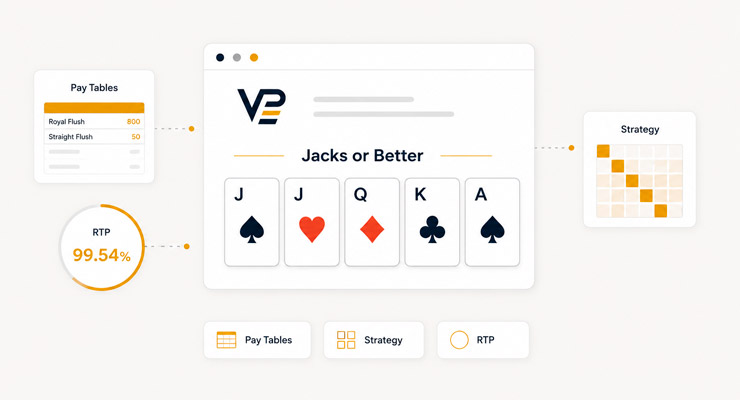
Jacks or Better is the baseline video poker variant: simple paytable, no wild cards, and a strategy structure that makes it the usual starting point for learning video poker math. The full-pay 9/6 version returns 99.54% with optimal strategy and max-coin play.
This section covers the three components that define the game: the pay table (which determines theoretical return), the strategy chart (which determines whether you reach that theoretical return), and specific hand scenarios that confuse new and intermediate players alike. For exact dealt-hand checks, use the Jacks or Better calculator to compare hold EVs against the active paytable.
For broader RTP context across video poker variants, see the video poker RTP guide.
Educational content only. Gambling rules, availability, and legal age vary by jurisdiction.
How Jacks or Better works
The game is a five-card draw video poker variant. You are dealt five cards, choose which cards to hold, discard the rest, and draw replacements. The lowest paying hand is a pair of Jacks, Queens, Kings, or Aces — hence the name. Higher hands pay according to the active paytable.
There are no wild cards, bonus multipliers, or special hand categories in the standard form. That simplicity is why this variant is often used as the reference game for video poker strategy: the return depends mainly on the paytable and the accuracy of the hold/discard decisions.
The math has been studied in depth since the 1980s. Michael Shackleford (Wizard of Odds) publishes the canonical optimal-strategy reference and return figures used across this site.
Three components
9/6 Pay Table
The full-pay reference paytable. Learn how to identify 9/6, why it returns 99.54% with optimal strategy and max-coin play, and how it compares with 8/6, 8/5, 7/5, and 6/5 variants.
Optimal Strategy
Practical 9/6 strategy chart with simple, intermediate, and optimal tiers, plus counterintuitive hold/discard decisions explained.
Trips and Three of a Kind
Three of a kind payouts, hold priority, and draw probabilities to four of a kind and full house from trips.
Why 9/6 matters
The “9/6” notation refers to two paytable rows: full house pays 9 credits per credit bet, and flush pays 6. Those two rows are the quickest way to identify the full-pay schedule. With optimal strategy and max-coin play, 9/6 Jacks or Better returns 99.54%.
Short-pay versions reduce one or both of those rows. An 8/6 game returns about 98.39%, 8/5 drops to about 97.30%, 7/5 drops to about 96.15%, and 6/5 drops to about 95.00%. That difference matters more than most small strategy refinements: choosing the wrong paytable can cost several percentage points of return before a single hand is played.
Identifying a true 9/6 paytable before play is the highest-value skill in the game. The title alone is not enough — two machines can both be labelled the same way while using different full house and flush payouts. For the full comparison table and identification checklist, see the 9/6 pay table guide.
Planned guides
Online Real Money
Guide to checking paytables in online game lobbies, including how demo and real-money versions may differ.
Strategy Trainer
Interactive optimal-strategy trainer for 9/6 with cost-of-error feedback.
The next major variant to study is Deuces Wild video poker, where wild cards change both the strategy chart and the paytable math.
