
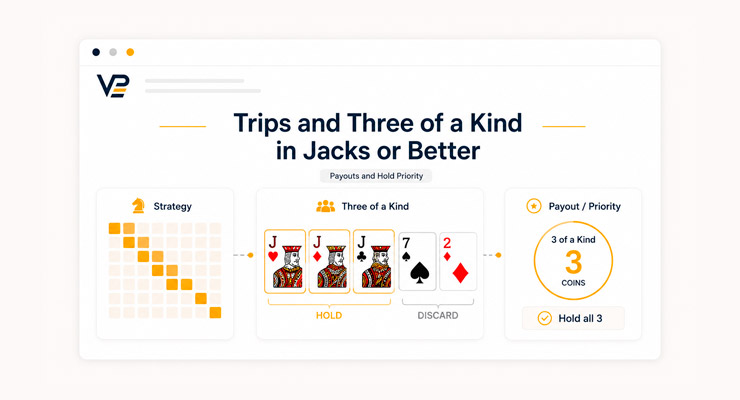
“Trips” is common poker shorthand for three of a kind — three cards of matching rank with two unrelated kickers. In Jacks or Better video poker, dealt trips are one of the clearest hold decisions: you keep all three matching cards, discard the two kickers, and draw two cards for a chance to improve to four of a kind or a full house.
This page covers what trips pay on the 9/6 paytable, where the hand sits in the optimal hold hierarchy, and the precise draw probabilities — including the exact expected value of holding pat trips.
For the complete optimal strategy chart with all priority lines, see the 9/6 strategy page.
Educational content only. Gambling rules, availability, and legal age vary by jurisdiction.
What “trips” means in Jacks or Better
“Trips” is informal terminology — borrowed from poker rooms and used commonly across video poker discussion — for the formal hand ranking “three of a kind.”
Both terms refer to the same thing: three cards of matching rank (such as three sevens, three Queens, three Aces) accompanied by two unrelated cards that do not pair either each other or any of the three.
In standard poker hand rankings, the hand sits between two pair (below it) and a straight (above it). In this game specifically, it is the fifth-paying category from the top, after royal flush, straight flush, four of a kind, and full house.
Trips arise in two ways during play. Most commonly, they are completed on the draw — a held pair pairs up with one of the two replacement cards. Less commonly, all three matching cards arrive on the initial deal, requiring no draw decision at all (the player simply holds the trips and draws two replacement cards in hope of an upgrade).
The frequency of being dealt trips on the initial five cards is approximately 1 in 47 hands.
Three of a kind payouts on 9/6 Jacks or Better
| Coins Bet | Three of a Kind Payout |
|---|---|
| 1 coin | 3 |
| 2 coins | 6 |
| 3 coins | 9 |
| 4 coins | 12 |
| 5 coins (max) | 15 |
Two things to note about this row of the paytable.
First, the three-of-a-kind payout is linear across coin counts — 3 credits per coin bet at all five wager levels. Unlike the royal flush, which jumps from 250× per coin at 1–4 coins to 800× per coin at max-coin, this hand has no bonus multiplier at max-coin.
This means the strategic reason to play max-coin is not about trips value — it is about the royal flush.
Second, the hand is a non-jackpot category. The payout structure is multiplicative (per coin bet) rather than exponential. It pays steadily but modestly. The financial appeal of the category comes from frequency, not size.
Hold priority when trips are dealt
The rule is unambiguous: when dealt this hand, hold all three matching cards, discard the two non-matching kickers, draw two. Always. There are no commonly encountered exceptions in standard 9/6 play.
In a condensed strategy chart, the hand usually appears near the top because several pat hands are grouped together. In the full Wizard of Odds 9/6 optimal chart, it is listed after dealt royal flush, straight flush, four of a kind, 4 to a royal flush, dealt full house, and dealt flush — with an expected value of 4.3025 credits per credit bet.
The practical rule is the same regardless of which chart version you consult: if you are dealt trips, hold all three matching cards and draw two.
The reason for holding is straightforward expected value. Pat trips deliver a guaranteed 3-credit payout per credit bet with substantial upgrade potential on the draw:
- Four of a kind completion — pays 25 credits per credit bet
- Full house completion — pays 9 credits per credit bet
- Trips retained on the draw — original 3-credit payout preserved
No four-card draw (flush, straight, straight flush, even royal flush) produces an expected value high enough to justify breaking pat trips. The combination of guaranteed minimum payout plus high-value upgrade probabilities makes this one of the stickiest hold decisions in the game.
For the position of this hand within the full priority chart, see the optimal strategy chart.
Drawing from trips — exact probabilities
When you hold the hand and draw two replacement cards, there are 1,081 possible two-card combinations from the 47 unseen cards.
The math: C(47, 2) = 47 × 46 / 2 = 1,081 total draw combinations. To test other outs, deck sizes, and draw counts interactively, use the video poker odds calculator.
The three possible outcomes:
- Four of a kind — 46 combinations, about 4.26% of draws, or roughly 1 in 23.5. One of the two drawn cards matches the rank of the held trips.
- Full house — 66 combinations, about 6.11% of draws, or roughly 1 in 16.4. The two drawn cards form a pair matching each other (not the held trips rank).
- Trips retained — 969 combinations, about 89.64% of draws. Neither of the above outcomes; the trips remain unchanged.
Using the 9/6 paytable, the expected value of holding trips is:
EV = (46 × 25 + 66 × 9 + 969 × 3) / 1,081 = 4,651 / 1,081 = 4.3025 credits per credit bet
This is substantially higher than the expected value of any four-card flush draw (around 1.91 credits) or four-card outside straight draw (around 1.53 credits). The math decisively favours keeping trips intact.
Common mistakes around trips
This hand is one of the least-misplayed categories in the game — the hold rule is simple and the expected value is overwhelming.
The mistakes that do occur tend to be specific impulse-driven errors:
- Breaking trips for a 4-card flush draw — the most expensive mistake. The trips EV (4.3025) versus 4-to-flush EV (about 1.91) means this play costs roughly 2.4 credits per occurrence
- Breaking trips for a 3-card royal draw — possible only in specific hands, such as the hand with two suited royal cards as kickers (for example, J♠ J♥ J♦ Q♠ K♠, where the 3-to-royal would be J♠ Q♠ K♠). Even then, the 3-card royal draw is far below trips in EV: Wizard of Odds lists 3 of a kind at 4.3025 credits per credit bet and 3 to a royal flush at approximately 1.2868. The hand should stay intact
- Holding only one of the three matching cards — rare confusion that abandons the entire guaranteed payout. Almost always a momentary misread of the dealt hand
- Forgetting to verify all three matching cards on the machine display — modern video poker machines display the dealt hand in any visible position, and the three matching cards may not be adjacent. Always confirm the structure before pressing draw
Common questions
Should I ever break trips in Jacks or Better?
No. In every reasonable scenario at the 9/6 paytable, holding pat trips delivers higher expected value than any draw alternative.
The closest theoretical edge case involves trips with two suited royal cards as kickers (for example, three jacks plus a suited queen and king). Even there, pat trips wins by a wide margin: EV 4.3025 vs 3-to-royal EV around 1.29.
Some variants of video poker — particularly Deuces Wild, where wild cards change hand-value calculus — shift this analysis. For pure 9/6 play, hold the trips.
Are “trips” and “three of a kind” exactly the same thing?
Yes. “Trips” is informal shorthand for “three of a kind.” Both terms refer to three cards of matching rank with two unrelated kickers.
The formal hand ranking name in poker and video poker is “three of a kind”; the informal name is what card players use in casual conversation, especially in poker rooms. Both terms are universally understood across casino and online play.
Methodology and sources
Three of a kind payouts on this page sourced from the Wizard of Odds 9/6 paytable.
Probability and combination counts (46 / 66 / 969 out of 1,081) computed from standard 52-card deck combinatorics for two-card draws from 47 unseen cards: C(47, 2) = 1,081.
Expected value figures (3 of a kind = 4.3025, 3 to a royal = 1.2868, 4 to a flush ≈ 1.91, 4 to an outside straight ≈ 1.53) verified against Wizard of Odds optimal-strategy methodology for 9/6 Jacks or Better.
For a broader comparison of how paytables affect theoretical return across video poker variants, see the Video Poker RTP guide.
Last verified 12 May 2026. See Editorial Standards for the full verification workflow.
