
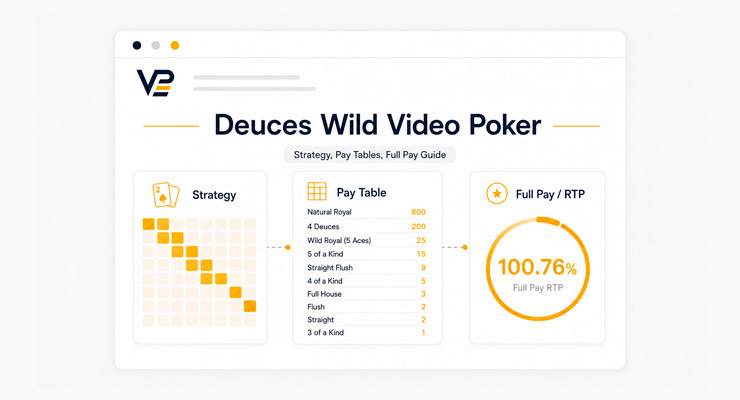
Deuces Wild video poker is a video poker variant where all four deuces (2s) function as wild cards — substitutes for any rank or suit during hand evaluation. The presence of these wild cards changes the math: paytables shift to compensate, optimal strategy differs sharply from Jacks or Better, and the lowest-paying hand becomes three of a kind rather than a pair.
The full-pay variant is identified by a specific paytable structure and returns 100.76% theoretical RTP with variant-specific optimal strategy and 5-credit play. That makes it one of the rare video poker schedules with positive theoretical expected value to the player, although availability is limited and short-term variance still matters.
This section covers strategy across all initial deuce-count scenarios — zero, one, two, three, or four deuces dealt — full-pay paytable identification, and variant-specific paytable differences. For cross-variant RTP context, see the video poker RTP guide.
Educational content only. Gambling rules, availability, and legal age vary by jurisdiction.
What makes Deuces Wild different
Two structural features separate Deuces Wild from Jacks or Better and other non-wild video poker variants.
First, the four deuces act as wild cards. A deuce in your hand counts as whatever rank or suit produces the best resulting hand. Hold a single deuce with three eights, and the deuce can complete four of a kind. Hold two deuces with Q♥, K♥, A♥, and the deuces stand in for 10♥ and J♥, completing a pat wild royal flush. A pat wild royal requires three natural royal-rank cards of the same suit; with fewer naturals, the wild royal becomes a draw rather than a made hand.
Second, the hand-ranking floor moves up. In Jacks or Better, a single high pair (Jacks through Aces) is the minimum paying hand. In this variant, pairs do not pay — three of a kind becomes the new minimum payout. The paytable compensates for the elevated frequency of strong hands (driven by the four wild cards) by reducing payouts on common hands like full house and flush.
The strategic consequence: Jacks or Better intuition does not transfer cleanly. Two pair is not a paying final hand here, and when no deuces are dealt the correct play is usually to hold only one pair rather than both. Pair and draw logic must be learned separately from Jacks or Better.
If you are coming from non-wild draw poker, compare with the Jacks or Better strategy chart; the role of pairs and two pair changes sharply once wild cards enter the deck.
Three components
Full Pay Strategy
The 100.76% RTP schedule under variant-specific optimal strategy and 5-credit play. Covers the 25-15-9-5-3-2 paytable, full-pay identification, and strategy refinements specific to the positive-EV version.
Strategy by Deuce Count
Strategy organised by the number of deuces dealt: zero, one, two, three, or four. Includes key hold rules, wild-card logic, and common mistakes from Jacks or Better players.
Pay Tables
Full Pay, Not So Ugly Ducks, Illinois Deuces, and short-pay schedules compared by per-credit payouts, RTP, and identification markers.
Full Pay versus short-pay Deuces Wild
The Full Pay schedule is commonly written as 25-15-9-5-3-2: Wild Royal Flush 25, Five of a Kind 15, Straight Flush 9, Four of a Kind 5, Full House 3, and Flush 2 (per credit, at any bet level). The Four of a Kind row is the fastest identification marker. If it pays 5 credits per credit bet (25 credits at 5-credit play), the game is a candidate for Full Pay. If it pays 4, the game is Not So Ugly Ducks, Illinois Deuces, or another short-pay variant — and the RTP gap matters.
Three variants are common enough to be worth recognising at a glance. RTP figures below assume variant-specific optimal strategy and 5-credit play; all figures sourced from Wizard of Odds analyses.
| Variant | Paytable (key rows) | RTP | Quick marker |
|---|---|---|---|
| Full Pay | 25-15-9-5-3-2 | 100.76% | Four of a Kind pays 5 |
| Not So Ugly Ducks | 25-16-10-4-4-3 | 99.73% | Five of a Kind pays 16 |
| Illinois Deuces | 25-15-9-4-4-3 | 98.91% | Four of a Kind pays 4 |
Short-pay variants below 98% also exist on some online platforms; their key rows reduce further (typically Full House to 2 and Flush below 3). The fastest way to verify any variant is to read the Four of a Kind row first, then the Full House and Flush rows. For the complete variant breakdown including short-pay schedules, see the Deuces Wild pay table comparison.
How strategy is organised
Strategy decomposes by the number of deuces in the initial five cards. The deuce count determines which sub-strategy applies, and each sub-strategy has its own priority list. The base rule across all sub-strategies: never discard a deuce.
The frequency distribution of deuces dealt on the initial five cards, computed from standard combinatorics (C(52,5) = 2,598,960):
- Zero deuces — 65.88% of hands
- One deuce — 29.95% of hands
- Two deuces — 3.99% of hands
- Three deuces — 0.17% of hands
- Four deuces — 0.00185%, or about 1 in 54,145 initial deals
Practical implication: zero-deuce strategy applies to two-thirds of all hands, so internalising that branch delivers most of the strategy value. One-deuce strategy covers nearly all of the remainder. Two-, three-, and four-deuce hands are rare enough that simple decision rules suffice without deep memorisation. For the full breakdown by deuce count, see the strategy guide.
Common questions
Is Deuces Wild beatable?
Theoretically yes, on the Full Pay variant only. The 100.76% RTP means that with variant-specific optimal strategy and 5-credit play, the long-run mathematical expectation is positive — about $0.76 per $100 wagered before considering comps, promotions, or progressive jackpots. However, this is a theoretical long-run figure: short-term variance is high (standard deviation roughly 5.18 per hand), bankroll requirements are substantial, and Full Pay availability has declined significantly over time. NSUD and short-pay variants are not beatable in the same sense — they have a small house edge under optimal play.
Which variant should I learn first?
Start with Full Pay strategy as the baseline, even if you do not currently have access to Full Pay machines. Two reasons. First, Full Pay is the reference variant — the optimal strategy chart for Full Pay is the most fully documented. Second, using Full Pay strategy on NSUD or short-pay machines costs only a small additional amount beyond the paytable RTP gap; the larger return difference always comes from the paytable itself, not strategy mismatch. For genuine NSUD or short-pay specialisation, learn the variant-specific chart after Full Pay is solid.
How is Deuces Wild different from Jacks or Better?
Fundamentally different in two ways. First, the minimum paying hand: Jacks or Better requires a pair of Jacks through Aces; the wild-card version requires three of a kind. Second, the strategy charts diverge sharply because deuces (as wild cards) shift hand-priority ordering. Two pair, the most common play change, is held as a pair in Jacks or Better but split to a single pair here. The chart and reasoning differ enough that mastering Jacks or Better does not translate directly. Both should be learned separately.
Where can I play Deuces Wild?
The game is available on most major online video poker platforms in jurisdictions where online gambling is regulated. Availability of Full Pay specifically is much more limited than NSUD or short-pay versions — most operators offer 99.73% or lower schedules. Verify the paytable before playing: read the Four of a Kind row first, then the Full House and Flush rows, to identify the variant. Availability and legality depend on your jurisdiction.
Coming soon
Bonus Deuces Wild
Bonus variant strategy refinements and paytable comparisons.
Online Paytable Checks
How to verify paytables in online game lobbies, including demo versus real-money differences.
Trainer
Interactive optimal-strategy trainer with feedback by deuce count.
Methodology and sources
RTP figures (Full Pay 100.76%, Not So Ugly Ducks 99.73%, Illinois Deuces 98.91%) sourced from Wizard of Odds Deuces Wild analyses, accessed May 2026. All figures assume variant-specific optimal strategy and 5-credit play.
Deuce-count frequency distribution computed from standard 52-card deck combinatorics: C(52,5) = 2,598,960 total hands; counts derive from C(4,k) × C(48,5-k) for k = 0, 1, 2, 3, 4.
Last verified 12 May 2026. See Editorial Standards for the full verification workflow.
