
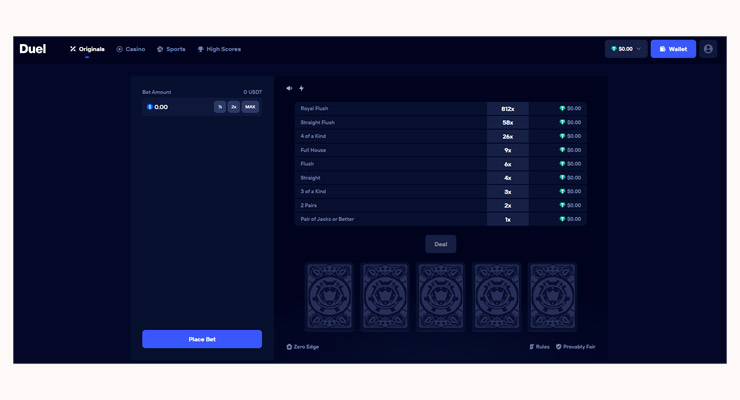
Duel Video Poker is a Jacks or Better draw-poker variant marketed at 100% RTP. That is unusual: even the strongest published video poker paytables typically sit between 99.5% and 100.8%, and a clean 100.00% figure is rare. This review documents what the claim actually means based on first-party data from the game interface, operator-stated mechanisms, and an approximate independent RTP check.
Educational content only. Gambling rules, availability, and legal age vary by jurisdiction.
Audit snapshot
| Game type | Jacks or Better draw poker, single hand |
|---|---|
| Visible paytable | 812× / 58× / 26× / 9 / 6 / 4 / 3 / 2 / 1 |
| Native paytable RTP | ~99.90% (operator-stated, supported by independent RTP check) |
| Marketed RTP | 100% within Zero Edge allowance, achieved via 0.1% instant rakeback |
| Allowance | $50,000 daily wagered or $1,000 per bet, 24-hour reset |
| Catch | Optimal strategy required; mistakes can equal or exceed the rakeback benefit |
| License | Anjouan Gaming (ALSI-202411026-FI1) — below Curaçao/MGA/UKGC tier |
Open Duel Video Poker
Check the live paytable, Zero Edge allowance, and current availability before playing.
What Duel Video Poker is
Duel Video Poker is one of nine in-house “Duel Originals” — provably fair single-player games developed by the operator. It is a single-hand draw poker title with a 52-card deck and standard Jacks or Better hand hierarchy. The in-game rules modal lists five rules: 52-card deck, choose hold or discard for each of five cards every round, replacements drawn from the deck, pairs only count from Jacks or better, only the highest combination is paid per hand.
The game has no wild cards, no multi-hand mode, and no progressive jackpot. Bet sizing uses ½, 2×, and MAX buttons rather than a traditional 5-credit structure — payouts are shown as displayed multipliers per unit wager. Wagering is in cryptocurrency — USDT by default, with BTC, ETH, USDC, LTC, DOGE, and several others supported.
The game was added to Duel’s Originals catalogue in early 2026. Duel itself launched in July 2025 under operator Immortal Snail LLC, with the founder publicly identified as Ossi Ketola, also the owner of CSGOEmpire.
The 100% RTP claim — what it actually is
The 100% RTP headline is the central marketing claim. Treated as a single number, it is misleading. Treated as a description of a two-part mechanism, it is accurate within stated limits.
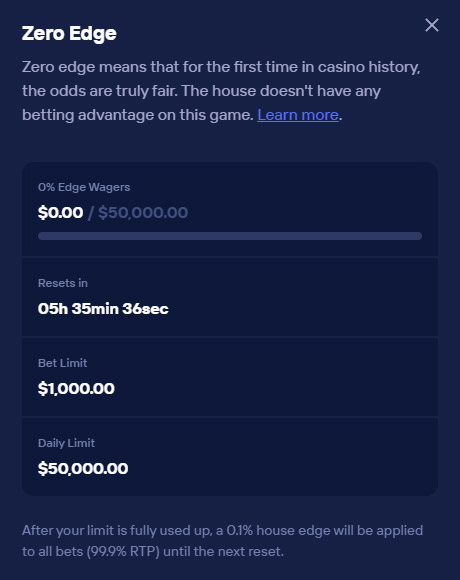
The native paytable RTP — what the math returns from the payouts alone, with optimal strategy and no rakeback — is approximately 99.9%. Duel’s own in-game Zero Edge modal states the position directly: “After your limit is fully used up, a 0.1% house edge will be applied to all bets (99.9% RTP) until the next reset.” That is the operator confirming, in their own interface, that the underlying game returns 99.9% — not 100%.
An approximate independent RTP check matches this directionally. Using standard 9/6 Jacks or Better optimal-strategy outcome probabilities with Duel’s visible payout changes (Royal Flush 812×, Straight Flush 58×, Four of a Kind 26×, otherwise 9/6 baseline), the implied native return is about 99.90%. Because the increased top-end payouts can slightly alter optimal-strategy decisions, a full exhaustive solver for the modified 812-58-26-9-6 paytable would be required to call the figure independently exact. The directional agreement between the operator-stated 99.9% and the cross-check value is the basis for confidence.
The “100%” comes from the second part: a 0.1% instant rakeback applied while the player is inside their daily Zero Edge allowance. The allowance is capped at $50,000 in total daily wagers or $1,000 per individual bet, whichever applies first, with a 24-hour reset. Inside that allowance, the 0.1% rakeback cancels the 0.1% house edge, producing a net 100% RTP. Outside the allowance — after $50,000 wagered in a day, or on any single bet above $1,000 — the rakeback stops and the game runs at the native 99.9%. To model those return assumptions before playing, use the Duel Video Poker calculator and guide.
The mechanism is the same model Duel applies to its other Originals (Dice, Crash, Mines, Plinko, Blackjack, Keno, Castle Roulette), and independent audits including 100rtp.games (April 2026) have documented it across multiple games.
The verified paytable
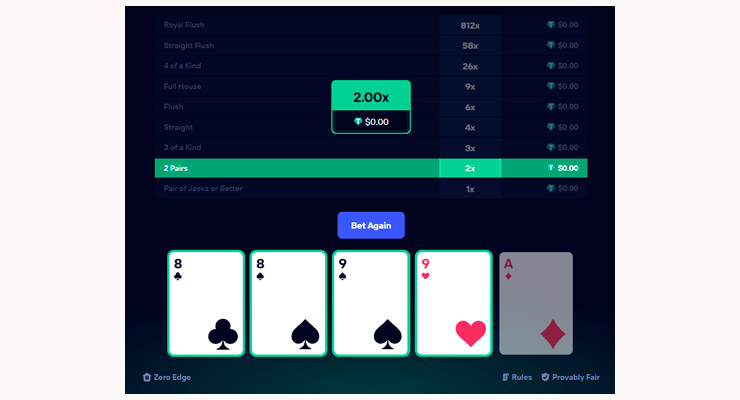
The paytable below is taken directly from the in-game payout panel as of May 2026. All values are displayed payout multipliers per unit wager:
| Hand | Duel pays | 9/6 J/B pays | Difference |
|---|---|---|---|
| Royal Flush | 812 | 800 | +12 |
| Straight Flush | 58 | 50 | +8 |
| Four of a Kind | 26 | 25 | +1 |
| Full House | 9 | 9 | — |
| Flush | 6 | 6 | — |
| Straight | 4 | 4 | — |
| Three of a Kind | 3 | 3 | — |
| Two Pair | 2 | 2 | — |
| Jacks or Better | 1 | 1 | — |
The paytable is structurally identical to 9/6 Jacks or Better with three payouts increased: Royal Flush, Straight Flush, and Four of a Kind. Full House and Flush — the two payouts that traditionally distinguish 9/6 from short-pay variants — are preserved at 9 and 6. Standard 9/6 J/B returns 99.54% under optimal strategy. The three payout increases contribute roughly +0.35 percentage points: about +0.24pp from the Four of a Kind bump (the most frequent of the three), +0.09pp from Straight Flush, and +0.03pp from the Royal Flush. The result is the ~99.9% native return that both the operator and the cross-check converge on.
For more on how paytable differences drive return changes, see the Video Poker RTP guide or the 9/6 Jacks or Better pay table reference.
Practical check: verify the current payout panel before wagering. Paytables can change, and the RTP claim depends on the live game rules.
Strategy assumption — why “100% RTP” can still produce losses
Video poker is a skill-sensitive game. The published RTP for any paytable assumes optimal play — the mathematically correct hold-or-discard decision on every initial deal. Mistakes cost real RTP, and on a paytable this close to breakeven, the cost of error is the difference between coming out ahead and losing.
The Duel paytable is close enough to standard 9/6 Jacks or Better that the 9/6 chart applies almost perfectly. The only theoretical adjustments are small shifts in marginal hold decisions where Royal Flush, Straight Flush, or Four of a Kind draws compete with made hands — small enough to be functionally indistinguishable from baseline 9/6 play.
The cost of error matters in concrete terms. For standard 9/6 Jacks or Better, simple play returns 99.46% versus optimal 99.54% — a cost of 0.08 percentage points, or one total bet every 1,178 hands. Intermediate play costs 0.03 percentage points. A 0.08-point mistake completely cancels the 0.1 percentage points the Zero Edge allowance gives back. A player using simple-rather-than-precise decisions on Duel Video Poker is, on net, getting roughly the same return as a perfect player on standard 9/6 — not the marketed 100%.
Concretely, over 1,000 hands at $5 per hand ($5,000 total wagered):
| Scenario | Theoretical RTP | Expected return | Difference vs Duel net |
|---|---|---|---|
| Standard 9/6 J/B, optimal | 99.54% | $4,977 | −$23 |
| Duel Video Poker (native, beyond allowance) | 99.90% | $4,995 | −$5 |
| Duel Video Poker (within allowance, optimal) | 100.00% | $5,000 | baseline |
| Duel Video Poker (within allowance, simple play) | ~99.92% | $4,996 | −$4 |
For the optimal strategy chart that applies (with negligible deviation) to this paytable, see the Jacks or Better optimal strategy page.
Strategy first, then paytable.
The 100% net figure assumes near-optimal Jacks or Better decisions; the strategy chart matters more than the operator.
Variance — why even 100% RTP does not mean predictable returns
Native 9/6 Jacks or Better has a variance per hand of about 19.51, with a standard deviation of approximately 4.42. The Duel paytable, with its slightly higher top-end payouts, has marginally higher variance — the larger Royal Flush, Straight Flush, and Four of a Kind multipliers concentrate more outcome value into rare hands.
The practical effect: realised session results swing widely around the theoretical mean even with optimal play. A 1,000-hand session can deviate by several percentage points from the 99.9% native RTP in either direction. Convergence toward the theoretical figure requires very large hand volumes — for a high-variance video poker game, on the order of hundreds of thousands of hands. The 100% RTP marketed by Duel is a long-run statistical mean, not a session expectation.
Provably fair verification
Duel uses a provably fair model for all Originals, including Video Poker. The in-game Provably Fair modal exposes three values: an active client seed (player-editable), an active server seed shown as a SHA-256 hash (committed by the operator before play), and a nonce (an incrementing counter for each round).
The verification flow is standard. The operator commits a server seed (publishing only its hash) before play begins. For each round, the game combines server seed, client seed, and nonce through a deterministic function — typically HMAC-SHA256 — to generate the card sequence. When the player rotates the seed, the operator reveals the previous server seed, allowing verification that the hash matches and that every round produced cards consistent with the published algorithm.
This system makes it mathematically infeasible for the operator to alter outcomes after the fact. It does not alter the paytable RTP — provably fair guarantees the shuffle is honest, not that the paytable is favourable. Those are independent questions. For Duel Video Poker, the shuffle is verifiable, and the paytable is approximately 99.9% native, 100% within the allowance.
The Zero Edge allowance — limits matter
The Zero Edge modal lists three operative numbers: $0 / $50,000.00 daily wager counter, a $1,000.00 per-bet limit, and a countdown to the next 24-hour reset. The footer text states explicitly: “After your limit is fully used up, a 0.1% house edge will be applied to all bets (99.9% RTP) until the next reset.”
For the typical recreational player, the limits are not binding. At a $5 total wager per hand and 200 hands per hour, reaching $50,000 in a single day would require roughly 50 hours of continuous play — structurally impossible inside the 24-hour reset. The $1,000 per-bet cap matters only for individual bets above that threshold.
For higher-stakes play, the limits bind faster. A player wagering $25 per hand at the same pace exhausts the allowance in about 10 hours; at $50 per hand and 300 hands per hour, the allowance is gone in roughly 3-4 hours. Beyond the allowance, the same game runs at the native 99.9% RTP. The 0.1% post-allowance house edge is still better than virtually every other video poker game available, but it is not the marketed 100%.
Comparison with standard video poker paytables
| Variant | Paytable | Theoretical RTP | House edge |
|---|---|---|---|
| Duel Video Poker | 812-58-26-9-6 (within allowance, with rakeback) | 100.00% | 0.00% |
| Duel Video Poker | 812-58-26-9-6 (native paytable, beyond allowance) | ~99.90% | ~0.10% |
| Deuces Wild | Full Pay (25-15-9-5-3-2) | 100.76% | -0.76% player edge |
| Jacks or Better | 9/6 (Full Pay) | 99.54% | 0.46% |
| Jacks or Better | 8/5 | 97.30% | 2.70% |
| Jacks or Better | 6/5 | ~95.00% | ~5.00% |
In context, Duel Video Poker is one of the strongest Jacks or Better-style paytables documented by VideoPokerEdge so far. Beyond the Zero Edge allowance, the 99.9% native return beats every Jacks or Better paytable on this site; within the allowance, the 100% net figure tops it further. Full Pay Deuces Wild retains a theoretical player edge (100.76%) by virtue of being a fundamentally different game family.
Operator context — license, withdrawals, reputation
Duel operates under Anjouan Gaming license number ALSI-202411026-FI1, issued to Immortal Snail LLC (registered in Charlestown, Nevis, West Indies). The Anjouan framework is a Comoros-based regulatory regime widely used by crypto-first operators. It is below the Curaçao, Malta (MGA), or UK (UKGC) license tiers in terms of player protection and formal dispute resolution.
The practical implication: in a dispute with the operator, players have limited regulatory recourse. The Anjouan framework does not currently maintain a public complaints register or mandated alternative dispute resolution. For high-stakes play, this matters; for casual play, less so. A practical risk-management approach for low-tier licensed crypto operators is to withdraw winnings to a private wallet frequently rather than holding balance on the platform, which limits exposure to counterparty risk. Restricted jurisdictions per the operator: United States, United Kingdom, France, Spain, Netherlands. Additional restrictions may apply based on local gambling law.
Withdrawal performance is described positively by multiple independent reviewers — cryptogamble.com, crashgamesplay.com, and btcgosu.com all report fast crypto payouts (often in minutes) for routine amounts, without manual review at standard volumes. KYC is not automatically required at registration; the operator describes it as triggered case-by-case for larger withdrawals or unusual activity. Third-party reports cite withdrawal caps in the range of $10,000 daily / $50,000 weekly / $200,000 monthly; these are not independently confirmed and should be verified in current terms before any large deposit.
Public user-review signals are mixed. Casino Guru’s Safety Index rates Duel at 7.6 (“above average”) with no unfair terms identified. Trustpilot-style review aggregators show a polarised distribution: positive themes cluster around fast withdrawals, transparent house-edge displays, and provably fair verification; negative themes include slot variance complaints, thin responsible-gambling tools, and individual reports of account limitations. Players considering significant deposits should review current public feedback directly before depositing.
Pros and cons
Pros
- Verified paytable. Payout panel, rules modal, and Zero Edge modal are all directly inspectable. Paytable values are consistent with the operator’s stated 99.9% native return.
- Honest underlying mechanism. The 99.9% native RTP is stated by the operator in their own interface; the “100%” headline is marketing simplification, not deception, once the allowance mechanism is understood.
- Best-in-class native return for J/B-style play. Approximately 99.9% paytable RTP is the strongest Jacks or Better-style return documented by VideoPokerEdge.
- Provably fair shuffle. Standard server-seed-plus-client-seed-plus-nonce verification with seed rotation.
- Fast crypto withdrawals. Fast routine crypto payouts reported by multiple independent reviewers (often in minutes for standard amounts).
- No predatory bonus structure. No wagering requirements, no opt-in bonus codes.
Cons
- “100% RTP” is conditional. Native paytable is ~99.9%, not 100%. The 100% figure applies only within the $50,000 daily / $1,000 per-bet allowance, and only with optimal strategy.
- Strategy errors can wipe out the benefit. A player using simple-rather-than-optimal strategy loses approximately 0.08 percentage points — comparable to the 0.1% the Zero Edge rakeback restores.
- Anjouan license tier. Below Curaçao/MGA/UKGC in player protection and dispute resolution.
- Crypto-only. No native fiat deposits or withdrawals.
- Responsible-gambling tools are thin. Limited built-in deposit limits, loss limits, or session controls. Players who need self-exclusion should set their own limits before depositing.
- Restricted jurisdictions. Players in the US, UK, France, Spain, and Netherlands cannot register.
- Variance applies fully. 100% RTP does not mean predictable returns.
Common questions
Is Duel Video Poker actually 100% RTP?
The native paytable returns approximately 99.9% RTP — stated by the operator in the in-game Zero Edge modal and supported by an approximate independent cross-check. The 100% headline figure is achieved through a 0.1% rakeback applied within a $50,000 daily wager allowance ($1,000 per bet), with a 24-hour reset. Inside the allowance, the rakeback cancels the house edge for a net 100% return; outside it, the game runs at 99.9%. Both halves require optimal strategy.
What strategy chart should I use?
Standard 9/6 Jacks or Better optimal strategy is a near-perfect fit. The Duel payouts deviate from 9/6 only in three top-end hands (Royal, Straight Flush, Four of a Kind) — those changes produce small theoretical adjustments to marginal hold decisions but no practical change in the chart. See the Jacks or Better optimal strategy page for the full chart.
Does the $50,000 daily allowance really matter?
For a recreational player, no. At a $5 total wager per hand and 200 hands per hour, reaching the allowance would require roughly 50 hours of continuous play. At a $25 wager per hand, the same allowance is reached in about 10 hours; at $50 per hand and 300 hands per hour, in roughly 3-4 hours. Beyond that, the game reverts to its native 99.9% RTP. The $1,000 per-bet cap also matters only for individual bets above that threshold.
Can players from any country play?
No. Duel currently blocks registrations from the United States, United Kingdom, France, Spain, and Netherlands. Additional restrictions may apply based on local law. Players should verify the operator’s current restricted-jurisdiction list and their own local gambling regulations independently before any deposit.
Verdict
Duel Video Poker is a mathematically competitive Jacks or Better variant with a verifiable paytable, a provably fair shuffle, and a transparent allowance mechanism. The “100% RTP” marketing claim is not deceptive once the mechanism is understood: the native paytable returns approximately 99.9%, and the 0.1% rakeback inside the Zero Edge allowance produces a net 100% within stated limits. The operator confirms this directly in the game’s own in-game text.
For players who already use optimal Jacks or Better strategy, who stay within the $50,000 daily allowance, and who can absorb variance over the long run, the game offers one of the strongest theoretical returns documented in its category. For players new to video poker, the benefit can be wiped out by strategy errors alone, and the Anjouan license tier offers thin dispute-resolution protection. The game is best understood as a strong reference paytable for skilled play, not as a get-rich vehicle on the strength of the headline number.
This review is affiliate-disclosed; the conclusion is based on the visible paytable, stated allowance terms, an approximate independent RTP cross-check, and operator-stated mechanisms documented in the live game interface.
Final check before playing
Duel Video Poker is only net 100% within the stated Zero Edge allowance and under optimal strategy. Verify the current rules, allowance limits, and jurisdiction restrictions before depositing.
Methodology and sources
Paytable, rules text, Zero Edge limits, and provably fair seed structure are documented from the live game interface (May 2026). The ~99.9% paytable RTP figure rests on two converging signals: (1) the operator’s own in-game Zero Edge modal text; and (2) an approximate independent cross-check applying standard 9/6 Jacks or Better outcome probabilities to the Duel payout schedule. A full exhaustive solver for the modified 812-58-26-9-6 paytable was not run; the directional agreement between the two signals is the basis for the figure.
Comparison figures (99.54% for 9/6 Jacks or Better, 100.76% for Full Pay Deuces Wild, short-pay J/B variants), variance values, and strategy tier costs sourced from Wizard of Odds optimal-strategy analyses. License verification (Anjouan ALSI-202411026-FI1, Immortal Snail LLC) cross-referenced across multiple secondary sources. Zero Edge mechanism corroborated by 100rtp.games (April 2026), btcgosu.com, cryptogamble.com, crashgamesplay.com, and Casino Guru.
This is an affiliate-disclosed review. The disclosure at the top of this page describes the commercial relationship. Editorial substance is not modified in exchange for commission. See Editorial Standards and the Affiliate Disclosure. Last verification: 12 May 2026.
